
News and Views
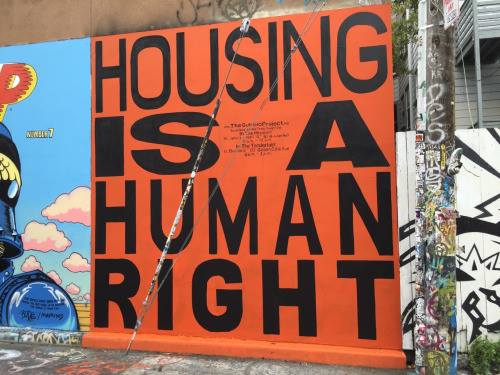
The first volleys were fired in a renewed Mission District housing battle on Thursday, as dozens of activists rallied at City Hall against a recently-resurrected housing project at 16th and Mission that would be the largest planned for the neighborhood.
It’s been just a week since the last pitched battle over housing in the neighborhood — a months-long affair concerning a 335-unit housing project on Bryant Street — ended in a loss for activists when the project was approved by the Planning Commission, though not without significant concessions from the developer.
June 9, 2016
There’s a scene in the dystopian scifi novel “Ready Player One” in which the protagonist glimpses the dossier of personal information a major tech company has gathered on him. It includes his height and weight, his browser history, his address — even several years of his school transcripts.
When the mainstream media cover housing affordability issues, journalists often hone in on gentrification. Young, mostly white, college educated people are moving into urban cities, they say, followed by yoga studios, coffee shops, and luxury apartments. This influx of affluent individuals allegedly fuels the displacement of the poor.
June 9, 2016
The 16th Street Bart Plaza where Spanish-speaking preachers blare sermons from portable amps and plaza regulars spend their days on benches in front of Burger King and Walgreens may soon transform into a square of glass towers, market-rate apartments, and an expanded marketplace — if a recently-resurrected housing project can defeat community opposition.
June 7, 2016
Supporters of an initiative to impose rent control and limit evictions on multi-family rental properties in the city of San Mateo were gathering signatures at St. Matthew and St. Timothy parishes as they aim to place the measure on the November ballot.
About 10,000 signatures are needed for the ballot measure to qualify, said Aracely Mondragon, community organizer for Bay Area Faith in Action, part of San Francisco Organizing Project/Peninsula Interfaith Action and the PICO National Network.
June 7, 2016
Today, Tenants Together, along with a majority of our member organizations, joined a broad coalition of housing rights activists concerned with the Governor's "By-right" development proposal. While we don't disagree with the need to build more housing in California, especially affordable housing, bypassing the community process for development means low-income tenants will get the short end of the stick.
June 6, 2016
San Francisco supervisors are set to consider legislation extending rent control protections to residents receiving federal housing subsidies for people with HIV/AIDS, following its approval in committee today.
The legislation was introduced by Supervisor Scott Wiener after he learned that people receiving subsidies under the federal Housing Opportunities for Persons with AIDS do not receive the same rent control protections as others.
Wiener said Monday:
“This will close a pretty glaring hole in our city’s rent control ordinance.”
Landlords will not be able to raise the rent on units that don’t meet basic maintenance standards under legislation passed unanimously Monday by the Seattle City Council.
Tenant-rights advocates cheered the bill’s approval and said it helped balance the power between renters and landlords at a time of skyrocketing housing costs and record homelessness in the city.
“Unfortunately, many people are living in substandard and unsafe housing,” said Roi-Martin Brown, a member of Washington Community Action Network (CAN), which advocated for the rule change.

June 6, 2016
A group of activists seeking a rent-control ordinance and other tenant-protection measures gathered in Ocean Beach on Saturday (June 4), circulating a petition they hope will convince the city council to open a dialogue concerning their grievances.
June 3, 2016
Last Friday the Senate Appropriations Committee declined to grant SB 1053 (Leno), the bill to stop Section 8 discrimination, a $350,000 appropriation. That means that the bill will not move forward for a vote in the Senate like we expected. Appropriations decided to attach a price tag to the bill to fund enforcement even though the bill did not even have a mandate for funding. This was a political decision to make it easier to kill the bill and avoid legislators having to go on record in support or opposition. In other words, cowardice.
This year for our annual event we're celebrating our collective work to make new rent control a reality in communities facing rising rents and displacement. This is a true coalition effort so we have a lot of awards to give out this year!
June 2, 2016
Robert Tillman owns a coin-operated laundromat in San Francisco’s Mission District, a neighborhood at the epicenter of California’s housing crisis. Over the last 2½ years, he’s spent nearly $500,000 on plans to tear down the business to build apartments. But although the city has zoned the property for apartments, Tillman hasn’t gotten very far.
It’s been 30 years since R&B star Gwen Guthrie released her smash hit “Ain’t Nothin’ Goin’ On but the Rent”—and it seems the song is more relevant than ever.
It’s impossible for workers earning $15 an hour or less to afford a modest two-bedroom apartment in any metropolitan area, county, or state in the nation, according to a study of the gap between wages and the price of housing by the nonprofit National Low Income Housing Coalition.
This is an apartment listing San Francisco residents can only dream about: $150 for a brand new, three-room apartment with a “tremendous fireplace.” Yes, it’s real — or it was in 1961. Today, a one-bedroom at the same address rents for $2,800 a month.
Rent control advocates announced Wednesday they have enough signatures to qualify their rent control and just cause for eviction ordinance for the November ballot.
The coalition behind the proposed ballot measure, called Fair and Affordable Richmond, said it would submit more than 5,000 signatures for verification at the Richmond City Clerk on Thursday. It is hosting a news conference at 12:30 p.m. Thursday at Richmond City Hall, 450 Civic Center Plaza.
June 1, 2016
When it comes to producing housing for people who don’t happen to be rich, solutions are becoming increasingly difficult to come by. This burden has fallen mostly on the federal government. However, cities have lately been finding ways to get the private home-building sector involved—namely through inclusionary zoning (IZ) policies. Such policies require developers to set aside a certain percentage of units in their buildings for sale or rent at below-market rates.
May 31, 2016
It's been nearly two months since the Oakland declared a 90-day moratorium on rent increases and evictions. But so far, the city's leaders have yet to revise Oakland's rental-housing laws. A tenants' coalition, which includes influential labor unions and community organizations, has been pressuring the council and mayor since April to place a rent control and eviction protection reform measure on the November ballot. And now it's getting political:
May 31, 2016
“A worker earning the federal minimum wage of $7.25 per hour would need to work 2.8 full time jobs, or approximately 112 hours per week for all 52 weeks of the year, in order to afford a two bedroom apartment at HUD’s Fair Market Rent (FMR).”—Out of Reach 2016.
According to a report from KSL-TV, tenants at City Park Apartments, in Salt Lake City, Utah, discovered a “Facebook addendum” taped to their doors on Thursday night demanding that they “Like” the apartment complex on Facebook within five days or be found in breach of the rental agreement.
“I don’t want to be forced to be someone’s friend and be threatened to break my lease because of that,” one tenant, Jason Ring, said. “It’s outrageous as far as I’m concerned.”
May 31, 2016
In his May 29 NY Times editorial, The End of Black Harlem, Michael Henry Adams portrays the historic African-American community as moving inevitably toward gentrification. He cites the familiar signposts—a Whole Foods, “stroller pushing young families,” and “new landscaping and yoga studios”—as well as more nefarious indicia such as white resentment over blacks living in “non-eviction coop conversions” at a fraction of the current market price.